Showing posts with label patients. Show all posts
Showing posts with label patients. Show all posts
Tuesday, December 20, 2016
Lavender Essential Oil Uses and its benefit for Cancer Patients
Lavender Essential Oil Uses and its benefit for Cancer Patients
Lavender Essential Oil Uses and its Benefits for Cancer Patients
By Marnie Clark
https://thetruthaboutcancer.com/cancer-benefits-lavender-essential-oil/
Total Shares 11.6K

In a hurry? Click here to read the Article Summary...
Very few essential oils evoke the passionate response that people have towards fragrances as lavender essential oil does. People either love it passionately or hate it just as passionately. When the latter group is asked what it is that makes them hate it… usually it has to do with a cranky grandmother who used lavender scent in her underwear drawer!
Love it or hate it, lavender essential oil has more uses and benefits than just about any other essential oil on the planet. This article will focus especially on its uses for cancer patients and provide some helpful tips for using lavender essential oil.
The botanical name of true lavender is Lavandula angustifolia. Although other types of lavender may also have beneficial uses, most of the research is on Lavandula angustifolia and it is the most highly regarded and therapeutic form of lavender.
Historical Use of Lavender Essential Oil
Lavender essential oil holds a special place in the world of herbs and has long been regarded for its wonderful healing properties. Its history goes back some 2,500 years to the ancient Egyptians and Phoenicians who used it for healing, embalming, and perfume. The Romans were known to use lavender for its medicinal and cleansing properties, scenting baths, as an insect repellent, and even for smoking!
During the times of the Black Death in England, lavender was used for protection against the plague. People actually fastened stalks of lavender to their wrists and ankles to protect them against the disease, not understanding the exact reason for that protection. Now we know why it worked… lavender repels the fleas that carried the plague!
In times of war when medicines and antibiotics were not readily available, soldiers were often given lavender oil to ease the pain of injuries and to kill any bacteria in their wounds.
We have now discovered hundreds more uses for lavender. It is known to be calming and relaxing to the nervous system, it eases depression, and improves cognitive performance. Lavender essential oil heals burns, eases allergy symptoms, kills bacteria, neutralizes the itch of insect bites, is a natural antiseptic and antifungal, and so much more.
One of the most interesting aspects of lavender essential oil, however, is how it helps cancer patients.
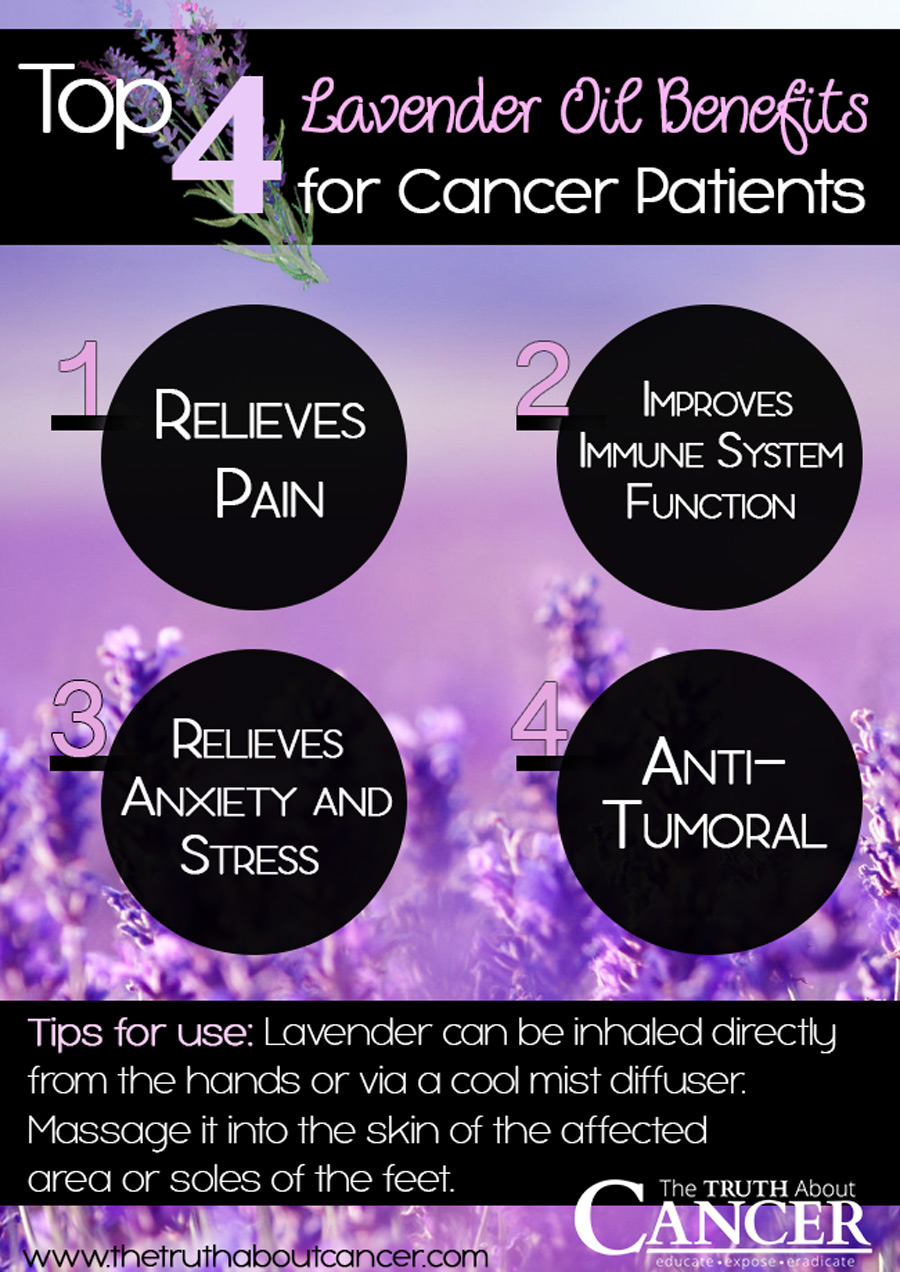
The 4 Best Benefits of Lavender Essential Oil for Cancer Patients
1. As an anti-tumoral. One of the active phytochemicals (plant chemicals) within lavender is perillyl alcohol. In 2015, researchers found that perillyl alcohol administered via nasal inhalation was an effective treatment for glioblastoma patients. These patients had become unresponsive to standard cancer therapies and faced a “dismal prognosis.” The study indicated that long-term inhalation of perillyl alcohol was very well tolerated over several years of daily use. (Several years means the patients lived much longer than expected!)
Another phytochemical within lavender is linalool. Recent (2016) research on linalool indicated it has “significant” cytotoxic (cancer cell killing) and apoptotic (programmed cell death) activity against epithelial ovarian cancer cells. In addition, researchers found that combining linalool with paclitaxel significantly decreased tumor weight, compared with the use of paclitaxel alone.
2015 research on linalool against human melanoma cells revealed that linalool had an inhibitory effect on the growth of these cells.
A 2014 study demonstrated that Lavandula angustifolia essential oil exhibited significant cytotoxic effects against malignant cervical cancer cells. It had the same effect on both estrogen- and progesterone-receptor positive breast cancer cells.
In another study from 2013, researchers found that Lavandula angustifolia decreased the viability of Hodgkin’s lymphoma cells. Lavender inhibited cell proliferation (rapid growth) and induced apoptosis (programmed cell death, lacking in cancer cells).
Tips for use: Using a therapeutic grade lavender oil, massage oil directly into affected areas. Used transdermally (through the skin), essential oils are absorbed into the bloodstream within about 20 minutes. Lavender essential oil can also be diffused into the room using a cool mist diffuser. Never heat essential oils as it ruins their therapeutic properties.
2. Relief of anxiety and stress. Lavender is excellent for its ability to calm the nervous system and ease stress and anxiety. It also helps improve the quality and depth of sleep. A 2009 study confirmed lavender’s ability to improve mood, and to reduce anxiety and depression.
Tips for use: Drip a few drops of lavender oil into your hands, rub hands together, and deeply inhale the scent for a minute or two to enjoy its calming effects. Lavender oil can also be diffused into the room using a cool mist diffuser. It can be applied to the soles of the feet prior to retiring to bed for the night. A drop or two of lavender oil can be applied directly on the pillow.
3. Improvement of immune system function. Studies show that the anti-bacterial effects of Lavandula angustifolia help to protect the immuno-compromised cancer patient from opportunistic bugs, even the dreaded Staphylococcus aureus, or golden staph. It influences the body’s macrophages and phagocytes, part of the immune system, and influences genetic activity to help fight the infection.
Tips for use: Massage lavender oil into the skin, making sure to use a therapeutic or medicinal grade of oil. The soles of the feet have the largest pores of the body, so this is a good place to apply essential oils, especially before going to bed at night. Lavender oil can also be diffused via a cool mist diffuser into the room where you work or study.
4. Pain relief. Lavender has long been used for pain relief. A small 2007 study using lavender examined the pain medication requirements of 54 patients undergoing laparoscopic gastric banding. Eighty-two percent receiving just a placebo required pain medication. Only 46% of those who received lavender by inhalation required pain medication. Also, significantly less pain medication was required by those receiving lavender as compared with a placebo.
Tips for use: Lavender can be inhaled directly from the hands or via a cool mist diffuser. Massage it into the skin of the affected area or soles of the feet.
Precautions When Using Lavender Essential Oil
1. Make sure your lavender essential oil is derived from true lavender, Lavandula angustifolia, and not lavandin. Lavandin is often substituted by makers of cheaper essential oils because it yields more oil than true lavender. Lavandin is not a legitimate substitute for Lavandula angustifolia as it does not possess the same healing properties and should never be used on burns.
2. The use of lavender may increase or potentiate both the narcotic and sedative effects of other drugs because of its calming effect on the central nervous system.
3. Be cautious about using lavender together with anticoagulant drugs because the combination may increase the risk of bleeding.
4. Never apply essential oils anywhere near the eyes or inside the ears.
5. It is not recommended to use essential oils as a sole treatment for cancer. But used in combination with other therapies (both conventional and alternative), essential oils can play a huge role in helping a person to heal.
Live your life without the threat of cancer. Go here to be notified each week about new, cutting-edge information that impacts your health.

Article Summary
- Whether you love or hate the scent, lavender essential oil has more uses and benefits than just about any other essential oil on the planet.
- Although other types of lavender may also have beneficial uses, most of the research is on Lavandula angustifolia and it is the most highly regarded and therapeutic form of lavender.
- Lavender essential oil holds a special place in the world of herbs and has long been regarded for its wonderful healing properties. It is used to heal burns, ease allergy symptoms, kill bacteria, neutralize the itch of insect bites, is a natural antiseptic and antifungal, and so much more.
- The 4 Best Benefits of Lavender Essential Oil for Cancer Patients include:
- As an anti-tumoral
- Relief of anxiety and stress
- Improvement of immune system function
- Pain relief
- There are several precautions that should be followed when using lavender essential oil:
- Make sure your lavender essential oil is derived from true lavender, Lavandula angustifolia, and not lavandin.
- The use of lavender may potentiate (increase) both the narcotic and sedative effects of other drugs because of its calming effect on the central nervous system.
- Be cautious about using lavender together with anticoagulant drugs because the combination may increase the risk of bleeding.
- Never apply essential oils anywhere near the eyes or inside the ears.
- It is not recommended to use essential oils as a sole treatment for cancer. In combination with other therapies essential oils can play a huge role in helping a person to heal.
[+] Sources and References
If you liked this article, get more articles and news like it by simply subscribing now for FREE:
If Cancer Scares You, Do Not Miss This...
See the Truth About Cancer here.
Over 20,000 people die each day from cancer. So if it scares you, that’s understandable.
However… whether you’re trying to avoid cancer or beat it if you’ve got it, there is one very powerful antidote to the fear, and to the disease itself: knowledge.
In “The Truth About Cancer: A Global Quest” you’ll discover the most powerful ways to prevent, treat, heal from, and beat the disease. Though you haven’t heard of most of these ways, you deserve to, so…
Click here now to conquer the fear, and find out what you really need to know.
?
Previous
This Popular Breast Cancer Drug is a Known Carcinogen (video)
?
Next
Cancer Fighting Recipe: Broccoli Sprouts Dip with Hemp Seed Oil
About Marnie Clark
Marnie Clark has been passionately studying natural medicine since 1995. She is a breast cancer coach, bodyworker, mother of one, grandmother of two, and is married to a wonderful man. In her “previous life” she was a legal secretary; a stressful job if there ever was one. Marnie’s driving force is to teach women patient empowerment and how to thrive during and after breast cancer. Her website is MarnieClark.com.
download now

Tuesday, December 13, 2016


Saturday, November 26, 2016
Special Needs Patients
Special Needs Patients
I recently had a couple of young patients who had Down’s Syndrome. Many of these patients have problems with the teaming of their eyes together. I referred them to the optometry school in the area which has a tremendous pediatric program.
I recently saw the parents of these patients. They couldn’t be more pleased. They raved about the attention their children received. They also presciribed vision trainaing which helped their children a lot.
The parents were so impressed with the care received, they are having the faculty of the school address their support group for Down’s Syndrome.
- Dr. Robert Rothbard
download now
Sunday, October 30, 2016
Stem Cell Transplant Can Help HIV Patients Battling Lymphoma Study MedlinePlus
Stem Cell Transplant Can Help HIV Patients Battling Lymphoma Study MedlinePlus
Stem Cell Transplant Can Help HIV Patients Battling Lymphoma: Study: MedlinePlus


Stem Cell Transplant Can Help HIV Patients Battling Lymphoma: Study
Outcomes after the therapy similar to those for patients who dont carry the virus


Wednesday, June 15, 2016
WEDNESDAY, June 15, 2016 (HealthDay News) -- People living with HIV are at high risk for lymphoma, and a new study concludes that stem cell transplant should be standard treatment in these cases.
The transplants should be "autologous" -- meaning the cells come from the patients themselves, the researchers said.
The new findings could challenge the widely held belief that HIV-positive patients are not candidates for this therapy.
Instead, the study found that "overall survival for patients with HIV infection after transplant is comparable to that seen in people who were not HIV-infected," said study lead author Dr. Joseph Alvarnas.
As his team explained, people with HIV are at increased risk for cancer, even if their infection is well-controlled with antiretroviral drugs. In fact, cancer is now a leading cause of death among HIV patients.
The risk of non-Hodgkin lymphoma, specifically in HIV-positive people, is up to 25 times higher than for people without HIV, Alvarnas team noted.
In an autologous stem cell transplant, healthy cells are removed from the patients own blood or bone marrow and administered to the patient to help recovery after high-dose chemotherapy.
Its already standard treatment for patients with relapsed and treatment-resistant Hodgkin and non-Hodgkin lymphoma, the researchers pointed out. However, the therapys use in HIV patients with these illnesses has been largely restricted to centers with HIV expertise.
Elsewhere, doctors have been reluctant to treat HIV patients with stem cell transplant, Alvarnas team explained. There have been concerns that these patients immune systems might not recover after intensive chemotherapy or that the procedure would cause toxicity or infections.
But is that necessarily so? To find out, the new study included 40 patients with HIV and lymphoma and 151 lymphoma patients without HIV. Patients in both groups received autologous stem cell transplants.
Overall survival among the patients with HIV was 87.3 percent after one year and 82 percent after two years, the study found. Thats barely different from the 87.7 percent one-year survival of patients without HIV, the researchers said.
The rate of transplant-related death -- from causes such as recurrence/persistence of the lymphoma, fungal infection or cardiac arrest -- among HIV patients was 5.2 percent. Again, that rate was comparable to patients without the virus, Alvarnas team said.
And one year after transplant, 82 percent of patients with HIV still maintained healthy, undetectable levels of HIV, according to the study published online June 13 in the journal Blood.
"These findings are remarkably important for a group of patients who, up until now, have been inconsistently treated," said Alvarnas, an associate clinical professor of hematology at City of Hope National Medical Center, in Duarte, Calif.
He believes that stem cell therapy can be of real value to lymphoma patients, including those with HIV.
"Transplantation allows clinicians to treat the cancer most effectively by using more intense doses of chemotherapy than can typically be given, while avoiding fears of wiping out the bone marrow," Alvarnas explained in a journal news release.
"Based on our data, autologous stem cell transplant should be considered the standard of care for patients with HIV-related lymphomas for the same indications and under the same circumstances that we would use it in patients without HIV infection," he said.
SOURCE: Blood, news release, June 13, 2016
HealthDay
Copyright (c) 2016 HealthDay. All rights reserved.
News stories are provided by HealthDay and do not reflect the views of MedlinePlus, the National Library of Medicine, the National Institutes of Health, the U.S. Department of Health and Human Services, or federal policy.
- More Health News on:
- HIV/AIDS
- Stem Cells
download now
Subscribe to:
Posts (Atom)