Showing posts with label update. Show all posts
Showing posts with label update. Show all posts
Tuesday, December 20, 2016
Final Update Summary Colorectal Cancer Screening US Preventive Services Task Force
Final Update Summary Colorectal Cancer Screening US Preventive Services Task Force
Final Update Summary: Colorectal Cancer: Screening - US Preventive Services Task Force
The U.S. Preventive Services Task Force released today a final recommendation statement on screening for colorectal cancer. The USPSTF recommends screening for colorectal cancer starting at age 50 years and continuing until age 75 years. The decision to screen for colorectal cancer in adults aged 76 to 85 years should be an individual one, taking into account the patient’s overall health and prior screening history. To view the recommendation and the evidence on which it is based, please go to http://www.

Colorectal Cancer: Screening
Release Date: June 2016
Recommendation Summary
| Population | Recommendation | Grade (Whats This?) |
|---|---|---|
| Adults aged 50 to 75 years | The USPSTF recommends screening for colorectal cancer starting at age 50 years and continuing until age 75 years. The risks and benefits of different screening methods vary. See the Clinical Considerations section and the Table for details about screening strategies. | The USPSTF recommends the service. There is high certainty that the net benefit is substantial. |
| Adults aged 76 to 85 years | The decision to screen for colorectal cancer in adults aged 76 to 85 years should be an individual one, taking into account the patient’s overall health and prior screening history.
| The USPSTF recommends against routinely providing the service. There may be considerations that support providing the service in an individual patient. There is at least moderate certainty that the net benefit is small. |
To read the recommendation statement in JAMA, click hereThis link goes offsite. Click to read the external link disclaimer.
To read the evidence summary in JAMA, click hereThis link goes offsite. Click to read the external link disclaimer.
Read Full Recommendation Statement
PDF Version (PDF Help )
)
PDF Version (PDF Help
)View archived versions of this recommendation
Related Information for Consumers
There is no related information for consumers.
Related Information for Health Professionals
There is no related information for health professionals.
download now

Sunday, November 27, 2016

Monday, October 24, 2016
Current Update Genomics CDC ► PRECISION PUBLIC HEALTH NEW CDC BLOG POST
Current Update Genomics CDC ► PRECISION PUBLIC HEALTH NEW CDC BLOG POST
Precision Public Health: Reconciling Biological and Social Determinants of Health | Genomics and Health Impact Blog | Blogs | CDC

PRECISION PUBLIC HEALTH: NEW CDC BLOG POST

Precision Public Health: Reconciling Biological and Social Determinants of Health
Posted on by
On June 6-7, 2016, I had the honor of participating in the “Precision Public Health” summit hosted by the Gates Foundation and the White House Office of Science and Technology at the University of California in San Francisco. The summit focused on developing a global “precision” agenda to improve health and prevent death and disease in the first 1000 days of life, but many of the concepts discussed apply throughout the life span. Experts from around the country explored how “big data” can be used to ensure that all children have the best opportunity to survive and thrive.
The meeting featured leaders from public health, healthcare, academia, industry, community organizations, philanthropic organizations, as well as patients. The meeting included presentations on several aspects of child health and development as well as focus of infant and child diseases of public health significance. Topics discussed included sudden death, prematurity, asthma, lead poisoning, infectious diseases, newborn screening, and others.
The concept of “precision public health” is relatively new. Of course, the “precision medicine” movement has taken off in the past few years, especially with the implementation of the precision medicine initiative in the US. If the goal of precision medicine is to deliver the right health intervention to the right person at the right time, the ultimate goal of precision public health is to develop and implement health interventions that can benefit the right populations at the right time. While implicit in the precision medicine concept is the use of genomic, behavioral, and environmental data in developing new and targeted interventions, more often than not, the discourse is about developing new drugs for treating cancer and other diseases. There is much less emphasis on joining biological with social/environmental determinants of health to develop and implement precision approaches to keep individuals and communities healthy.
For two days, participants heard about examples of increased precision in public health approaches with a clear focus on social and environmental determinants of health. The passion and commitments exhibited by participants were quite impressive. Breakout groups tackled many topics including, among others, building a definition and success criteria for the field of precision public health, engaging communities in precision public health, integrating various sources of environmental data for policy and decision support, and creating a Precision Social Justice Toolkit.
As we eagerly await the summary write-up of this event, I reflect briefly on the three essential elements of precision public health.
Data: As the data deluge continues, we have a unique opportunity to use information from multiple levels both “below the skin” (genomics, omics, molecules) and “above the skin” (behavior, environment, place, policies) to have a more coherent picture of determinants of health and disease in each population. As discussed at the meeting, there are ongoing studies (e.g. asthma) and near term opportunities for linking existing data and applying new tools of measurement to get a more complete picture of health and disease in relation to time, place and persons. Better and more precise measurements of environmental and social determinants of health and their interactions with our biology could lead to more focused interventions that are not “just drugs, genes and diseases.”
Action: One important take home message is that data are not enough! New and more precise population health data should be used to develop and implement actions that can improve health and prevent disease. Actions can include treatments, prevention strategies, policies, and programs. The “precision” in action will be based on evidence that ties population data to measurable outcomes in subpopulations stratified by persons, place, and time. Action is also multilevel (e.g., individual, family, community, societal) and multisectorial (healthcare, education, housing, etc.) Solving health problems of children (and adults) will involve both the private and public sector using decision support tools and community data to impact health and policy and program decisions.
A focus on equity: A fundamental concern for public health is promoting health equity by reducing health disparities among groups of people. Throughout the summit, there was a focus on addressing health equities in populations both in the US and globally. If precision medicine is to succeed as a movement, its’ benefits need to reach all segments of society. Starting with equity in mind, population data collected should not only document that inequities exist, but influence actions and solutions to address them. Dr. Sue Desmond-Hellman articulated this emphasis on equity, in her recent TED talk and reiterated again at the summit. For example, on the topic of precision surveillance she said:
“…let’s say, for example, we find out in certain areas of Africa that babies are dying because of a bacterial infection transferred from the mother to the baby,known as Group B streptococcus. In the absence of treatment, mom has a seven times higher chance that her next baby will die. Once we define the problem, we can prevent that death with something as cheap and safe as penicillin. We can do that because then we’ll know. And that’s the point: once we know, we can bring the right interventions to the right population in the right places to save lives.”
Precision approaches can also be applied to other global health problems, such as malaria, HIV, cervical cancer, and more.
In closing, I believe that precision public health is not a “me, too” movement that is attempting to divert attention from the important work of precision medicine, but an essential public health partner that can leverage new tools and technologies to measure health in populations and to develop the right interventions that will benefit all segments of society. The work is just getting started to establish collaborative processes, networks, governance and tools to build a strong evidentiary foundation for precision public health.
Categories genomics, public health
Current|Update|Genomics|CDC
download now
Saturday, October 1, 2016
Cancer Update
Cancer Update
Cancer Update

Cancer Update
MedlinePlus sent this bulletin at 06/16/2016 01:11 PM EDTNew on the MedlinePlus Cancer page:
Tobacco and Cancer
06/09/2016 02:02 PM EDT
Source: American Cancer Society
download now
Monday, September 26, 2016
PCH Update
PCH Update
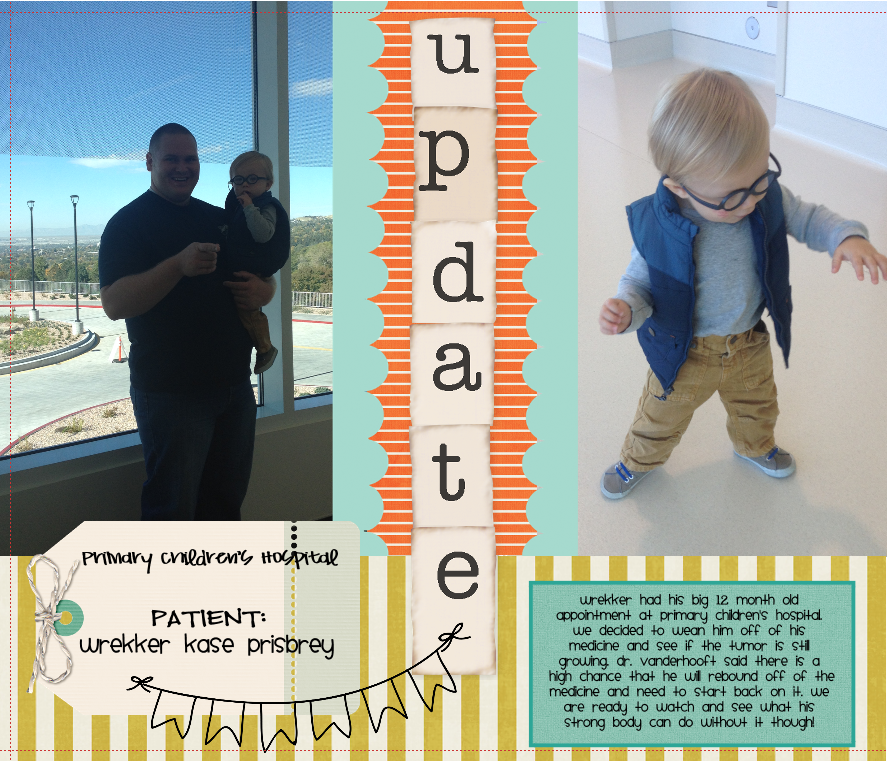
Wrekker had his big 12 month old appointment at Primary Childrens Hospital. We decided to wean him off of his medicine and see if the tumor is still growing. Dr.Vanderhooft said there is a high chance that he will rebound off of the medicine and need to start back on it. We are ready to watch and see what his strong body can do without it though!
download now
Thursday, August 18, 2016
Swimming update
Swimming update
I was able to accompany Matthew to his first swimming lesson of the new year today. Hes still in stage 1, but is now one of the better swimmers in the group. He was able to swim across the small pool on his back without stopping, and although he had to stop a couple of times while swimming on his front, he definitely seems to be better than the last time I saw him. He swims with his face in the water (wearing goggles), but apparently the instructors like this because one of the targets for stage 2 is to not be afraid to swim with your face under the surface. The only problem is that he stops swimming and stands up to catch his breath - he needs to learn to pull his head up for air while swimming, which I guess will come with practice.
This evening, Matthew tried mouthwash for the first time (we bought him one for 6+) but he found it hard not to swallow it. He got upset when he swallowed a small amount because we warned him it would be dangerous (in an attempt to make sure he didnt swallow it!). Ive told him that hell have to practice with water until hes able to use the mouthwash.
download now
Subscribe to:
Posts (Atom)